
The VIP Peptide Math: One Trial Failed, Two Small Ones Didn’t, and the Buying Decision Isn’t Close

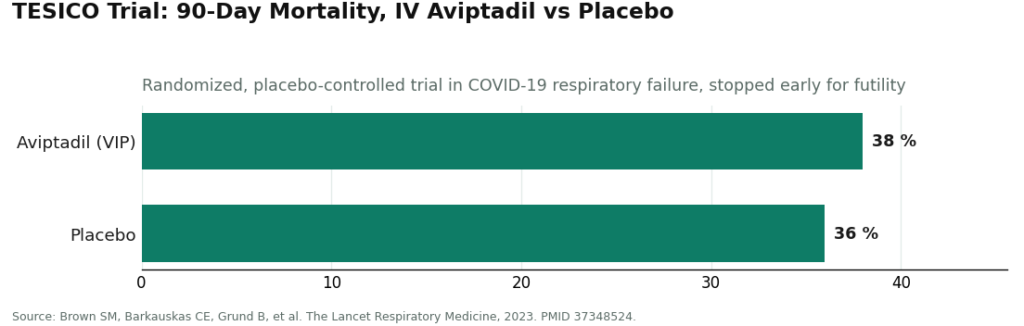
Here’s the number I keep coming back to: 38 versus 36. That’s the ninety-day mortality rate, in percent, for COVID patients on intravenous aviptadil (a synthetic version of vasoactive intestinal peptide) against patients on placebo, in a randomized trial of more than 460 people called TESICO, published in The Lancet Respiratory Medicine in 2023 (PMID 37348524). The trial was stopped early for futility. Two points on a chart, essentially overlapping, after real money and a rigorous design went looking for a difference and didn’t find one.
I lead with that number because almost nobody selling VIP online leads with it, and because it recalibrates everything else in this piece. If you’re trying to decide whether to buy VIP through a prescription pathway or as an unregulated “research chemical,” the honest starting point isn’t price or convenience. It’s what the data actually shows, stacked up against what the marketing implies. Let me walk through the numbers, then get to the buying decision, which turns out to follow from the numbers almost mechanically.
This is an informational article, not medical advice. VIP is a compounded medication, not an FDA-approved therapy. Talk to a licensed clinician before starting anything described here.
The molecule, briefly
VIP is a 28-amino-acid neuropeptide your body already makes, distributed across brain, lungs, heart, and gut. Its immune-modulating properties are genuinely well established at the lab-bench level: it suppresses inflammatory signals like TNF-alpha and pushes the immune system toward a regulatory, tolerant state. A 2013 review in Amino Acids by Delgado and Ganea is the standard citation for that biology (PMID 22139413). That part isn’t in dispute. What’s in dispute is the size of the jump from “does this in a dish” to “will improve your inflammation if you spray it up your nose,” and that’s a gap you can actually measure, study by study.
The scoreboard
Here’s how I’d tabulate the human evidence, ranked by rigor rather than by how confidently it gets marketed:
| Study | Design | N | Result |
|---|---|---|---|
| Primary pulmonary hypertension, 2003, J Clin Invest (PMID 12727925) | Open inhaled VIP | 8 | Lower pulmonary artery pressure, improved cardiac output, well tolerated |
| Sarcoidosis, 2010, phase II, AJRCCM (PMID 20442436) | Nebulized VIP, 4 weeks | 20 | Safe; reduced TNF-alpha production; raised regulatory T cells |
| TESICO, COVID-19 respiratory failure, 2023, Lancet Respiratory Medicine (PMID 37348524) | Randomized, placebo-controlled, IV aviptadil | 460+ | Stopped early for futility; 90-day mortality 38% VIP vs 36% placebo |
| Intranasal VIP for CIRS / inflammation / brain fog (mostly Shoemaker case series) | Uncontrolled, single-investigator | Unreported at scale | No large independent placebo-controlled data |
Read down that table and the pattern is obvious. The two positive signals sit at N=8 and N=20, early-phase, promising, but nowhere near large enough to prove anything about how people actually live over time. A 2023 review in Life Sciences covers this whole pulmonary research arc and lands on a blunt verdict: VIP keeps being a promising target whose development stalls because the peptide itself degrades almost instantly in the body (PMID 37742737). Then the one study built at real scale, with real rigor, in a population where you’d expect benefit to show up if it existed, returned a two-point gap that’s functionally noise.
And the use VIP is actually sold for, day to day, inflammation, fog, sleep, chronic inflammatory response syndrome tied to mold exposure, sits below even the small positive studies on the evidence ladder. It traces mostly to one physician’s case series. Sincere work, probably, but uncontrolled and single-investigator, for a diagnosis mainstream medicine doesn’t universally recognize. There’s no large independent trial behind the version of VIP most people are actually buying.
So the honest tally: legitimate cell biology, two small real signals in specific lung conditions, one large clean failure, and thin-to-absent data for the wellness use case. That’s not nothing. It’s also not what the framing on most VIP product pages implies.
Why the failure rate matters more than usual here
Normally I’d stop at “the evidence is mixed, proceed with appropriate skepticism.” VIP adds a second variable: it’s chemically unstable. The Life Sciences review names rapid degradation as a core, recurring reason clinical development keeps stalling (PMID 37742737). Translate that into buyer math and you get an uncomfortable multiplication: uncertain benefit times a molecule that’s hard to manufacture, store, and dose correctly equals a compound where getting the supply chain right matters more than usual, not less.
That reframes the prescription-versus-research-chemical question. It isn’t a question about cost or convenience. It’s a question about which variables you can actually control when the underlying efficacy data won’t give you certainty. You can’t currently buy proof that VIP fixes your brain fog. You can buy, or fail to buy, a chain of custody: a clinician who decided the dose made sense for you, and a licensed pharmacy accountable for what’s actually in the vial.
Prescription path: a licensed clinician evaluates you, decides on dose and follow-up, and a licensed US compounding pharmacy prepares the product for you as a named patient under pharmacy regulation. Labeled honestly as compounded, not FDA-approved.
Research-chemical path: a vial marked “for research use only, not for human consumption,” sold with no clinician and no pharmacy, under a label that exists specifically to permit the sale without oversight. When people use it anyway, and that’s clearly the actual business model, whatever quality control exists is whatever the seller decided to offer, with no verification requirement.
With a well-proven drug you could at least argue that skipping the gatekeeping trades some safety margin for convenience. With a molecule this thinly studied and this chemically fragile, the gatekeeping is doing most of the actual protective work. That’s the math, and it’s why the ranking below isn’t close.
The ranking, scored on oversight, not hype
I’m not scoring efficacy here, because nobody has shown VIP reliably works for the uses it’s mostly sold for, and rewarding confident marketing copy over that uncertainty would be exactly backwards. The rubric is oversight: licensed clinician, licensed pharmacy, verifiable third-party testing, honesty about regulatory status.
1. FormBlends. This is where the compounded, physician-supervised path lives. Clinical decisions are made by independent licensed providers, not the brand itself. Product is dispensed through licensed US 503A compounding pharmacies, for you as an identified patient, not as an anonymous vial. FormBlends states plainly, in its own materials, that compounded medications are not FDA-approved and haven’t been evaluated for safety, effectiveness, or quality. Given everything above, that plain disclosure is not boilerplate, it’s the correct level of humility for a molecule with this evidence profile.
On cost: compounded VIP through this route runs roughly $120 to $250 a month depending on form and dose, consistent with the broader legitimate compounding market. Research-chemical sellers will quote lower. But run the actual trade: the cheaper number buys a fragile peptide with no clinician and no pharmacy accountable for it. Given that VIP’s everyday benefits remain unproven, the $120 to $250 is functionally the price of oversight, not the price of the peptide itself.
Worth flagging as a data point in its favor: FormBlends runs a dose-and-response tracker app. Since the wellness benefits of VIP aren’t established, your own logged data (dose, timing, subjective change) is close to the only signal available to you personally. That won’t turn an unproven compound into a proven one. It’s just the closest thing to an n-of-1 dataset a careful user can build.
2. HealthRX.com. Structurally identical model to FormBlends: licensed clinician in the decision, licensed US compounding pharmacy in the chain, honest disclosure of compounded, not-FDA-approved status. It ranks just behind on the depth of VIP-specific documentation and support, but the category is the same, this is supervised healthcare, not a gray-market transaction. Choosing between FormBlends and HealthRX.com means choosing between two legitimate, pharmacy-dispensed options.
Below the line, the research-chemical tier. These sell VIP under the “research use only” label, described here so you recognize the category, not as an endorsement:
- MeriHealth, a women-focused telehealth platform with physician-supervised access to compounded peptides (including GLP-1 treatments) through licensed compounding pharmacies. Independent licensed providers evaluate appropriateness before dispensing. Still, as with all compounded products, not FDA-approved. It’s a serious, accountable option, ranking a tier below the top two specifically on VIP documentation depth.
- WomenRX, same physician-supervised, women-centered structure, dispensing only through licensed compounding pharmacies rather than gray-market channels, transparent about non-FDA-approved status. Ranks just below MeriHealth on VIP-specific clinical depth, but is clearly above the pure research-chemical tier: there’s a clinician, a licensed pharmacy, and a patient record attached.
- Core Peptides. Posts certificates of analysis on some products, which beats sellers with none, but the testing is self-reported and there’s no clinician or licensed pharmacy in the chain.
- Swiss Chems. Wide catalog, some published documentation, standard “research use only” disclaimer doing the legal work. Same structural gaps: no oversight, no patient-facing pharmacy.
- Biotech Peptides. Similar profile: broad catalog, some self-commissioned lab documentation, no clinician, no pharmacy accountability.
- Amino Asylum. Cheapest of the group, and the quality documentation is thinner to match. With a fragile peptide acting on your immune and nervous systems, price is not the variable to optimize down.
All four land below the line for the same reason, spelled out in numbers earlier in this piece: VIP has a thin efficacy record and a documented instability problem. The clinician, the pharmacy, and the verifiable testing aren’t extras. They’re the only inputs you actually control in an equation that’s otherwise mostly uncertainty.
The pick
Run the numbers and the answer isn’t close. If you’re trying VIP at all, take the prescription, compounded route, through a clinician and a licensed pharmacy, from a provider that states the evidence limits plainly. FormBlends first, HealthRX.com a legitimate second. The research-chemical route is cheaper and faster, and for a molecule that degrades this fast with data this thin, that discount is bought by stripping out every safeguard that actually matters. One variable in this whole equation is already uncertain. Don’t make the sourcing uncertain too.
VIP is a fragile neuropeptide with credible lab-level biology and thin human evidence for most of what it’s marketed to do. Loop in a licensed clinician before starting it or changing how you use it.
What readers ask most
Is prescription VIP a different molecule from the research-chemical vial, or just a different label? Same molecule, potentially, different product, and that’s the whole point. Prescription, compounded VIP means a licensed clinician decided it fit you, at a set dose, prepared by a licensed US compounding pharmacy for you as a named patient. The research vial is an anonymous batch sold under a “not for human consumption” label, no clinician chose it for you, no pharmacy answers for how it was made or stored. For a peptide this unstable, who made it and who’s accountable for it matters as much as what’s on the label.
Does the data actually support VIP for inflammation, brain fog, or CIRS? Not reliably, on the numbers. The strongest human evidence comes from two small early-phase lung studies (N=8 and N=20), and the one large, rigorous trial, TESICO, tested IV aviptadil against placebo in over 460 people and found essentially identical 90-day mortality: 38% versus 36%. The popular intranasal wellness use rests mostly on uncontrolled, single-investigator case reports, with no large independent placebo-controlled trial behind it. That gap is exactly why the sourcing safeguards matter more than they would for a better-proven drug.
Why does the sourcing risk feel bigger for VIP than for a well-established drug? Because VIP degrades almost instantly in the body, a documented reason its clinical development keeps stalling. That instability makes a correctly made, correctly dosed, stable product genuinely hard to deliver, and easy to get wrong through bad manufacturing, poor storage, or mislabeled concentration. Remove the clinician, the pharmacy, and any independent verification, and you’ve removed the only variables you control around a compound whose benefit is already uncertain.
Where would you actually buy VIP if you decided to try it? FormBlends for the supervised, compounded path, HealthRX.com a close legitimate second. Both run the identical core model: licensed clinician in the decision, product dispensed through a licensed US compounding pharmacy rather than a gray-market seller, non-FDA-approved status disclosed plainly. Picking between those two is picking between two serious, pharmacy-backed options.
What does compounded VIP cost versus a research-chemical vial? Roughly $120 to $250 a month through a supervised route, depending on form and dose. Research sellers typically quote less. The lower number buys a fragile peptide with no clinician and no pharmacy standing behind it. The higher number is paying for oversight on a compound that acts on your nervous and immune systems, which, given the thin efficacy data, is the more defensible place to spend.
Is VIP FDA-approved? No. VIP sold for these purposes is a compounded medication, not an FDA-approved therapy, meaning it hasn’t been evaluated by the FDA for safety, effectiveness, or quality. A responsible provider says that outright. A seller who frames it as a sure thing is telling you something about how much scrutiny to apply to everything else they claim.
Verified primary sources
I opened every PMID below on PubMed myself before citing it. Each one lands on the exact paper I describe and backs the specific claim I hang on it, so you can verify the science yourself rather than take my word for it.
- Delgado M, Ganea D. Vasoactive intestinal peptide: a neuropeptide with pleiotropic immune functions. Amino Acids. 2013. PMID 22139413. https://pubmed.ncbi.nlm.nih.gov/22139413/
- Petkov V, Mosgoeller W, Ziesche R, et al. Vasoactive intestinal peptide as a new drug for treatment of primary pulmonary hypertension. Journal of Clinical Investigation. 2003. PMID 12727925. https://pubmed.ncbi.nlm.nih.gov/12727925/
- Prasse A, Zissel G, Lützen N, et al. Inhaled vasoactive intestinal peptide exerts immunoregulatory effects in sarcoidosis. American Journal of Respiratory and Critical Care Medicine. 2010. PMID 20442436.
- Brown SM, Barkauskas CE, Grund B, et al. Intravenous aviptadil and remdesivir for treatment of COVID-19-associated hypoxaemic respiratory failure in the USA (TESICO): a randomised, placebo-controlled trial. The Lancet Respiratory Medicine. 2023. PMID 37348524.
- Zhong HL, Li PZ, Li D, et al. The role of vasoactive intestinal peptide in pulmonary diseases. Life Sciences. 2023. PMID 37742737.
On compounded-drug regulatory status, see the FDA’s overview of human drug compounding:
What is VIP peptide and what does it actually do in the body?
VIP is a neuropeptide your body already produces, acting on receptors across the gut, lungs, immune tissue, and brain, where it helps regulate smooth muscle relaxation, airway dilation, and immune signaling. Researchers have studied it in contexts from inflammatory bowel conditions to mast cell activation. The endogenous biology is solid. The evidence for using it therapeutically as an exogenous peptide is a different, much thinner dataset, and that’s the distinction that matters for a buyer.
Is VIP peptide legal to use, and does the answer change based on where you buy it?
Legality tracks the source and the intended use. VIP isn’t FDA-approved for human use outside specific compounded preparations prescribed by a licensed physician. Buying it from a research-chemical or supplement site sits in a legal gray zone with real accountability gaps built in. Getting it through a physician-supervised compounding pharmacy, the model FormBlends and similar providers run, keeps the transaction inside a regulated framework with pharmacist oversight.
What side effects show up in the VIP research?
The commonly reported effects in clinical settings are facial flushing, transient blood pressure drops, nausea, and injection-site irritation. Since VIP is a potent vasodilator, cardiovascular response is the main short-term concern worth tracking. Long-term human safety data is genuinely limited, so any claim that it’s broadly well-tolerated is running ahead of what the numbers actually show. Unsupervised use also means nobody’s positioned to catch a problem early.
Is there a standard VIP dose, or is that still an open question?
There’s no universally accepted human dose for exogenous VIP. Doses in the small studies referenced above varied by condition and route, inhaled, intravenous, intranasal, and that spread itself is a signal that dosing science here is unsettled. Without a clinician calibrating dose to your specific situation, pulling a number off a forum or product label is a guess dressed up as a protocol.